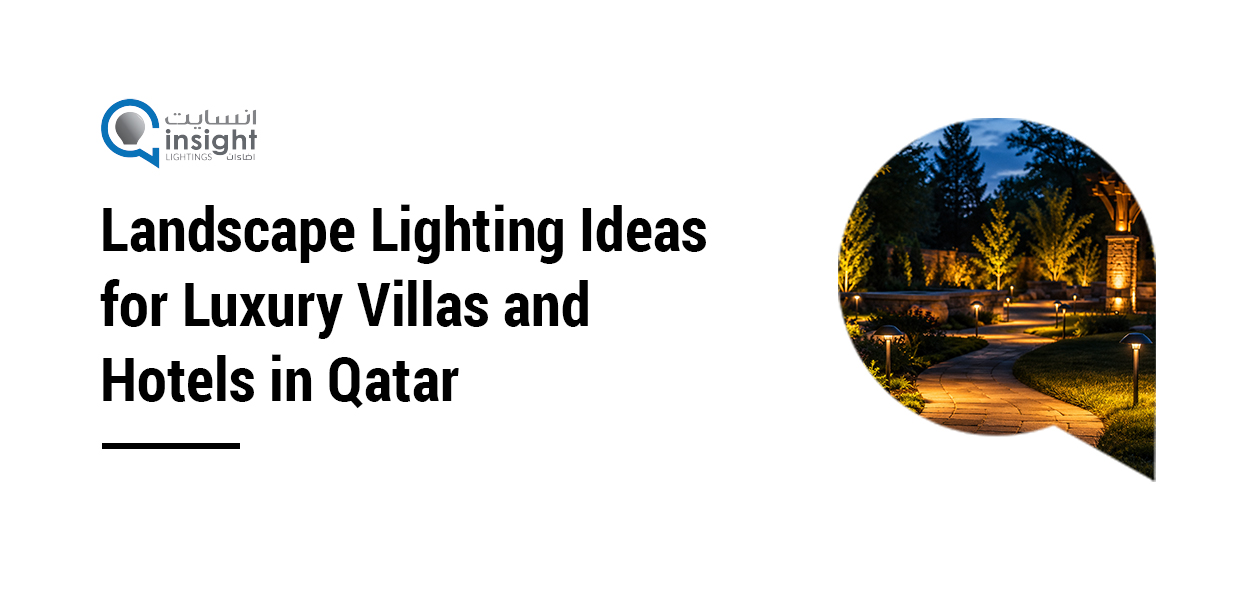
Doha at night has a split personality. There are properties — genuinely expensive ones — that go completely dark after sunset. You wouldn’t know they were there unless you already knew. Then there’s that one place on the same street that somehow stops you. Maybe it’s a palm lit from below. Maybe it’s an entrance that doesn’t blind you but still feels deliberate. Whatever it is, the building looks intentional after dark in a way the others don’t.
It’s rarely about the architecture itself. Almost always, it comes down to whether anyone thought seriously about lighting before the project finished.
That’s a gap worth closing — especially in Qatar, where outdoor entertaining matters, competition between properties is real, and first impressions move fast.
The Entrance Gets Judged Before the Door Opens
Nobody’s first experience of your property starts at the front door. It starts at the gate — the driveway, the pathway, whatever’s between the car and the building.
In Qatar, that stretch is often long. Big compound walls, feature plantings, carved stonework near the entrance. Impressive during the day. They lose their impact at night if they’re not properly lit.
Bollard lights along a driveway — height and spacing done right — turn that walk into something that reads like an arrival rather than just a functional path. Step lights recessed into risers handle the safety issue quietly, without throwing in visible fixtures that compete with everything else going on visually.
Uplighting on a compound wall or entrance column is probably the single best-value move in landscape lighting. One fixture, aimed properly at the base of textured stone, shows carving and depth that daytime photographs honestly don’t capture. It costs relatively little and changes the feel of an entrance completely.
A Garden That Stops at Sunset Is Half a Garden
Qatar’s outdoor season is real — October through to late April, roughly. That’s six months where residents and guests actually want to be outside. If the garden only works during daylight hours, you’re missing out on how the space feels at night. That’s dinners, gatherings, quiet evenings — all gone.
Uplighting on palms is the obvious move, and it works because date palms genuinely earn it. The fronds carry and scatter light in ways that feel natural rather than staged. The fixture goes low, close to the trunk, aimed upward through the canopy — the result is a tree that reads as a landmark. Not just a plant.
For planting beds, warm LEDs (2700K–3000K) make greenery look natural at night. They also suit stone and sandy surfaces better than cool white lights.
Pools are their own conversation. Permanent underwater fixtures — built for submersion — turn a pool from a daytime amenity into the focal point of the whole outdoor space at night. Moving water and light together do something no surface-mounted fixture can replicate. The reflections extend onto surrounding walls and planting and make the entire area feel larger than it is.
A Hotel Facade That Goes Dark Is Losing Something Every Night
Hotels in Qatar compete hard on identity. The building itself is part of the brand — and if it disappears after sunset, that’s a missed opportunity repeated every single evening. Strong villa lighting design in Qatar focuses on highlighting structure without overpowering it.
Wall-grazing works particularly well here. Mount a fixture close and parallel to a textured surface. Let the light travel across it at a low angle. This brings out shadow and depth in carved details and patterns. Qatar’s sandstone cladding and Arabic-influenced decorative screens respond to this better than almost any other surface. Flat floodlighting just kills the texture entirely.
Linear LED strips or low-profile uplights along cornices and rooflines give a building back its silhouette after dark — structure, geometry, character. Not a white box. Something that actually reads as a building worth looking at.
Qatar’s Climate Will Destroy the Wrong Fixtures
LEDs have made landscape lighting more practical — lower energy use, longer life, less maintenance. That’s genuinely good.
What doesn’t change is this: fixtures rated for mild European climates will not last the same way in Doha summers. 45°C sustained heat, fine airborne sand, and coastal salt humidity are collectively brutal on outdoor hardware. IP ratings need to match actual site exposure — not just what looks acceptable on a spec sheet. Thermal management inside the fixture body matters more than people realise when ambient temperatures are already extreme before the light even switches on.
Smart controls let feature lighting run only when the property needs it — scheduled, zoned, dimmed appropriately. Running costs fall without touching the guest experience.
Working with the Right Lighting Partner
Insight Lightings is based in Doha and covers landscape lighting supply and installation across Qatar. They handle everything from outdoor and architectural lighting to facade, underwater, and landscape lighting — from design to installation.
Get in touch to plan your landscape lighting: insightlightings.com