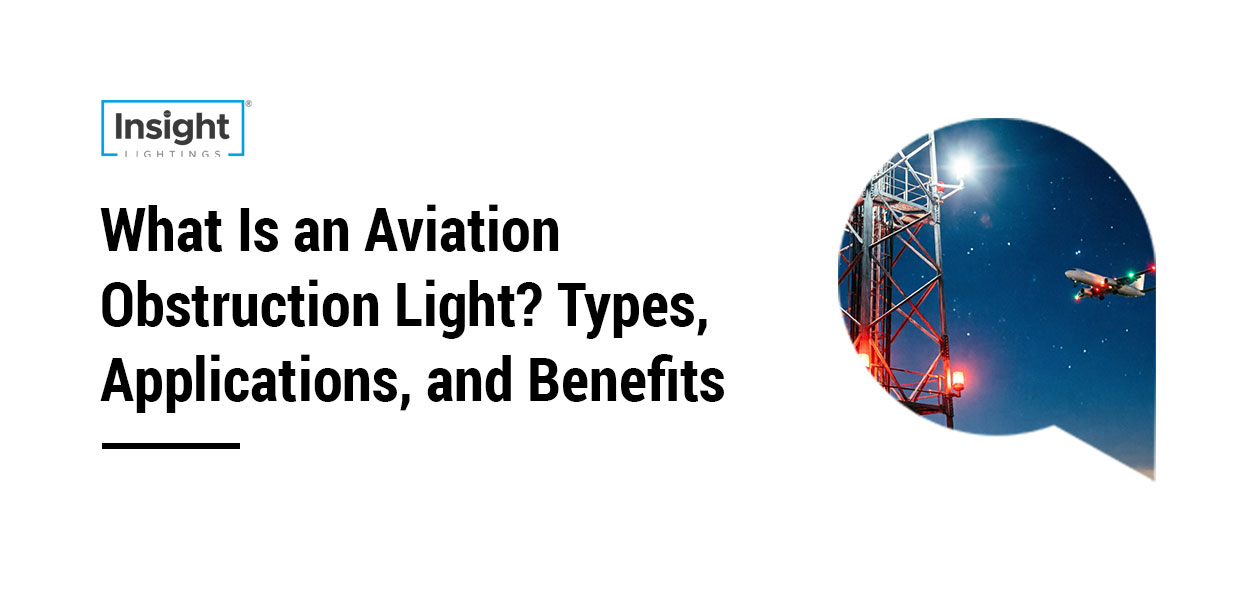
Look up at any city skyline after sunset. While driving or walking elsewhere, you may see some towers or structures which have some red or white flashing lights. Most individuals don’t give thought to what they mean. However, that’s somewhat of a problem. As urban areas build upwards, the spaces above them become a lot more congested. Still, helicopters, transient planes, and emergency services fly at lower levels. When tall structures are poorly marked, the risk is real.
Aviation obstruction lights exist to solve this exact problem, yet they are often treated as a last-minute compliance item instead of a safety system.
That gap in understanding is where many projects go wrong.
What is an aviation obstruction light?
Obstruction lights are lights mounted on tall buildings to warn aircraft of their presence. They indicate to pilots that there are obstacles in the flight path.
These lights work day and night. Some are steady. Some flash. All of them serve one purpose. Prevent collisions in shared airspace.
Next, it is important to understand that not all obstruction lights are the same.
Types of aviation obstruction lights
Different structures create different levels of risk. That is why aviation obstruction lights are divided by intensity.
Low-intensity lights
These are usually red. They are used on shorter structures or where visibility risk is low. They are mainly for nighttime marking.
Medium-intensity lights
These are brighter and often white or red. They suit mid-height buildings, towers, and chimneys. They work well in areas where aircraft activity is frequent.
High-intensity lights
These are very bright white lights designed for tall or critical structures. They are visible from long distances and are often used on skyscrapers, high masts, and major infrastructure.
Then comes the practical question. Where are these lights actually used?
Applications in real environments
Aviation obstruction lights are installed on:
- Buildings with multiple floors
- Telecommunication and broadcast relay towers
- Tall industrial stack and chimney structures
- Cranes used in construction
- Wind turbines
- large outdoor constructions
Any structure that rises into navigable airspace needs clear visual marking. There are no exceptions that make sense in practice.
After that, the benefits become obvious.
Benefits that actually matter
The initial advantage is safety. With good eyesight, one can hardly bump into other aircraft, even if the weather is very bad.
Next is compliance. The requirement of the Aviation Authority must be met by obstruction lighting. If one does everything correctly the first time, they will save themselves from having to pay fines, waiting for permission, and spending money on redesigning.
Then comes reliability. Modern LED obstruction lights last longer and need less maintenance. That reduces operational downtime.
Finally, there is accountability. Proper lighting shows that safety was considered, not ignored or rushed.
Why this matters more than people think
Obstruction lighting is not about ticking a box. Disregarding risk is a reality that no one benefits from. Insight Lighting is more than just a light supplier. They contemplate the location, objective, and approach of the light utilisation. While designing or evaluating a new or existing project, acquiring expert advice is necessary. Insight Lighting can provide answers and appropriate solutions for any aviation obstruction lighting questions and requirements.